Why Don’t My Coping Skills Work Anymore?
You’ve done the breathing exercises, the journaling, the grounding techniques. You know how to calm your body in the moment. But lately, it feels like those tools…

And why that doesn’t mean something is wrong with you.
You go to therapy. You know your coping skills. You exercise, or at least you try to. You’re self-aware enough to know when you’re struggling and resourceful enough to do something about it.
And yet…
You’re snapping at people you love over things that shouldn’t matter. You’re dropping balls you’ve never dropped before. You’re falling behind at work and can’t quite explain why. You’re waking up at 3am, or doom scrolling until midnight, or pouring a glass of wine before you’ve even thought about whether you want one.
You look fine from the outside. You’re still showing up. But something is off, and you can’t figure out why, because you’re doing everything you’re supposed to do.
Here’s what I want you to hear: It’s not you. It’s the moment we’re living in.

I work with a lot of high-functioning people: planners, achievers, people who have always been able to count on their own competence to get through hard things.
Lately I can see it on them before they say a word. In their face. In their posture. In the way they wave it off, call it “silly,” and tell me they just need to pull it together.
What they’re describing is a shared experience, and they’re far from the only ones feeling it. In the American Psychological Association’s 2025 Stress in America survey, most adults named societal division as a significant source of stress.
The world feels unpredictable in a way that is genuinely destabilizing. The news can keep you on low-grade alert all day. And the future, which planners depend on being able to map out, feels uncertain in every direction.
Stress this big and this constant doesn’t always show up the way you expect it to. It creeps in sideways.
It shows up as snapping at your partner over dishes. Crying in your car on the way home for no reason you can name. Lying awake even though you’re exhausted. Losing your patience with your kids and then feeling terrible about it. Staring at your screen at work and getting nothing done.
It can also show up as checked out and numb, like you’re going through the motions but not quite present in your own life. That’s what nervous systems do when the environment is overwhelming and the threat feels too big to address directly.

Here’s the specific cruelty of this moment for people like you.
You solve problems. You make plans. You rely on your own capability, and that has always worked.
But this is too big and too far outside your control to solve or plan your way out of. So you feel the weight of it without being able to do much about it. That gap, between the pressure and the helplessness, is agonizing for people who are wired to fix things.
The stress has nowhere to go, so it spills into your sleep, your relationships, your body, and your focus.
You’re human, in an overwhelming moment, carrying more than any one person should have to carry.
I know what a lot of people reading this are thinking.
Everyone is going through the same thing. I don’t have it that bad. I have plenty of reasons to be grateful. I just need to push through.
Yes. Everyone is going through it.
And everyone needs support right now, whether that’s therapy, community, or something else entirely. Being one of many who are struggling doesn’t mean your struggle doesn’t count, or that you should white-knuckle it on your own.

When clients dismiss their own pain, I often ask them to try this: Imagine your closest friend came to you describing exactly what you just described to me. Would you tell them to suck it up?
Of course not. You’d tell them it makes sense. That they deserve support. That struggling doesn’t mean they’re failing.
You deserve that same compassion. If that’s hard to offer yourself, the Self-Compassion Break is a two-minute place to start.
There’s something else I see in high-functioning people that I want to name directly.
When you’re the capable one, the one others rely on, not being on your A game can feel like a moral failure. If you’re not performing, you don’t have worth. If you need help, something must be really wrong.
That shame keeps people minimizing and pushing through until they can’t anymore.
So here’s what I’d offer instead: struggling right now is a healthy response to an unhealthy situation. Your nervous system is responding to an environment that is genuinely hard, and the problem is much bigger than any one of us.
Getting support doesn’t mean someone hands you a solution or fixes the state of the world. If I could do that for you, trust me, I would.
It looks like having someone reflect back that what you’re feeling makes sense.
It looks like being seen clearly, without judgment, and letting other people be there for you.
It looks like some insight into what’s driving the irritability, the numbness, the sleeplessness.
It looks like working on the things within your control, and loosening your grip on the things that were never yours to manage.
It looks like less pressure. Less shame. A little more room to breathe.

Yes. Ongoing uncertainty in the world around you can raise your stress level even when your own life looks stable. It often shows up indirectly, as irritability, poor sleep, trouble focusing, or feeling numb.
If you’ve felt low, on edge, or checked out most days for two weeks or more, or it’s getting in the way of work, relationships, or sleep, it’s worth talking with a licensed provider. Our post Is It Burnout or Depression? can also help you think it through.
No. Many people get the most out of support when they reach out early. You can find a provider or start with your own doctor. If you are in crisis, call or text 988.
If you’ve been holding it together for a long time, in a world that keeps getting harder to hold together in, and you’re starting to notice the cracks, that’s your body telling you something true.
You don’t have to have it all figured out before you ask for help. You don’t have to wait until you’re really falling apart. You can reach out now, while you’re still mostly okay and could use someone in your corner.
Feeling the way you’re feeling is reason enough.
Bailey C. Bryant, Psy.D. is the Founder and Steward of Hello Mental Health, a group therapy practice in Cincinnati, Ohio.
This post is for general education only. It isn’t therapy, medical advice, or a diagnosis. For care that fits your situation, talk with a licensed provider. If you’re in crisis, call or text 988.
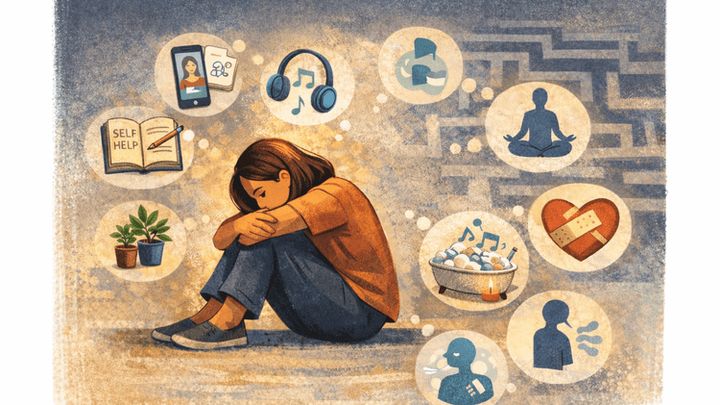
You’ve done the breathing exercises, the journaling, the grounding techniques. You know how to calm your body in the moment. But lately, it feels like those tools…
When I was growing up, my mom had lots of self-helpy books on her shelf. The middle school me never picked them up, but some of the titles stuck in my brain. For…

You’ve been wondering whether therapy might be right for you. Maybe things feel a little harder than usual, or you’ve been carrying the same worries for longer than…