Why Are High-Functioning People Falling Apart Right Now?
And why that doesn’t mean something is wrong with you. You go to therapy. You know your coping skills. You exercise, or at least you try to. You’re self-aware…

Spoiler: It’s not a personal failing. It’s an alliance of forces working against you.
A client sits across from me and describes their week. They’re exhausted. Burnt out. Running on fumes.
I ask, “When did you last rest?”
They pause. Think. Usually, they can’t come up with an answer.
Or they say something like: “I rested on Sunday afternoon. Well, I sat on the couch. But I was folding laundry while I watched TV. And I kept thinking about everything I needed to do. So I don’t know if that counts.”
Honestly? That’s not really rest.

They were multitasking, staying productive, keeping the guilt at bay by staying busy.
And when I gently suggest they might need real rest, the kind where they’re not doing anything productive, the response is almost always the same:
“I can’t. I have too much to do.”
“Maybe when things slow down.”
“I’ll rest when everything is finished.”
“I don’t deserve to rest yet.”
This is rest guilt. And if you’re reading this and nodding, you’re not alone.
Here’s what I want you to understand first: rest guilt has nothing to do with a lack of discipline or a character flaw.
It comes from a lot of forces that have been shaping you your whole life:
Cultural conditioning: Especially in the U.S. and the Midwest, hard work is a virtue. Productivity feels like morality. Busyness is a status symbol.
Family-of-origin messages: What you learned growing up about what makes you worthy, good, and deserving.
Faith and community values: Many families, communities, and faith traditions place real value on hard work, service, and putting others first. Those are good values, and they can also make rest feel indulgent.
Peer expectations and comparison: Everyone else seems busy and accomplished. If you’re resting, it can feel like you’re falling behind.
Work culture and productivity pressure: When your worth feels tied to your output, rest only seems acceptable if it makes you more productive later.
Nervous system adaptations: If you grew up with stress, responsibility, or survival mode, your body learned that staying alert and busy keeps you safe. Slowing down can feel dangerous.
So rest guilt lives in your body as much as your head.

In my therapy work, rest guilt shows up as:
Anxiety
When you finally sit down, your heart races. Your mind spins. You feel like you’re missing something.
Restlessness
You can’t just be still. You have to be doing something, even if it’s small. Even if it doesn’t matter.
Trouble enjoying downtime
You’re physically resting but mentally running through your to-do list.
The belief that rest must be earned
You can only rest when everything else is finished. Which, of course, never actually happens.
Rest that feels wrong
Uncomfortable. Undeserved. Not restful at all. Just… bad.
I see rest guilt in all kinds of people. But I see it especially in:
High achievers
Anxious and perfectionistic people
People carrying a lot of caregiving or emotional labor
Immigrants and children of immigrants who feel pressure to succeed or “make it worth it”
People navigating cultural expectations, minority stress, or systemic barriers
If you live in a culture that ties your worth to your productivity, you’re vulnerable to rest guilt, no matter who you are.

Here’s the cruel irony: when people finally do try to rest, anxiety often spikes.
You sit down. You tell yourself you’ve earned it. And instead of feeling relaxed, you feel like you’re forgetting something important, falling behind, being lazy, or letting people down.
Old messages surface: “I should be doing something productive.” “Other people are working harder than me.” “I don’t deserve this.”
For some people, the discomfort is so strong that they avoid real rest altogether. It’s easier to just stay busy.
That spike is your nervous system reacting to slowing down, and it usually eases with practice.
In my experience, two beliefs cause the most damage:
If you’re resting, you must be lazy. And lazy is bad. Lazy is weak. Lazy is unacceptable.
So you stay busy for the sake of being busy. You put off rest indefinitely. You live in a constant state of “I’ve almost earned it, but not quite.”
You can’t rest until everyone else is taken care of. Until every responsibility is met. Until you’re no longer needed.
If you’re a caregiver, a parent, a partner, or someone who works in a helping job, that means never.
These beliefs keep you trapped.
I’m not going to tell you to:
Take a week-long vacation
Overhaul your whole routine
Spend an hour a day meditating
Quit your job and prioritize yourself
Advice like that often ignores real life: caregiving demands, financial constraints, single parenting, chronic illness, and seasons where rest is genuinely limited.
Sleep does matter a lot. The National Institutes of Health calls it a basic human need, like eating and breathing, and if you’re struggling with it, it’s worth talking with your doctor. But I’m not going to hand you a perfect routine that doesn’t fit your actual life.

Instead of all-or-nothing solutions, I want you to think about micro-rests.
Rest doesn’t have to be big. It doesn’t have to be perfect. It doesn’t have to be done well.
Rest can be:
A cup of tea, sitting down, doing nothing else
A five-minute walk
Listening to one song without multitasking
Sitting in your car for five minutes before going inside
Lying on the floor and staring at the ceiling
Think of it as the minimum effective dose: the smallest amount of rest that makes you feel even slightly different.
Some days, that’s an hour. Some days, it’s five minutes. Some days, you don’t have even that, and that’s okay too.
What matters most is the interruption. Stop. Breathe. Pause. Downshift, even briefly. (If you want a place to start, try the Micro-Break Practice.)
I also want to widen your definition of rest. Besides physical rest, there’s:
Emotional rest: not having to manage other people’s feelings
Mental rest: not having to make decisions or solve problems
Social rest: not having to be “on” or perform
Sensory rest: quiet, dim lighting, less stimulation
Sometimes what you need most is permission to not be needed for ten minutes.
And rest should not become another performance metric. You don’t have to optimize it, track it, or make sure it’s “good enough.” Rest is not another thing to fail at.
Rest guilt runs deep. It’s built into our culture, our families, and our nervous systems.
But it doesn’t have to be in charge.
You can start small. You can experiment. You can notice when the guilt comes up and gently question it.
You can rest, imperfectly, briefly, without permission, and still be worthy.
Because you already are.
Is it really okay to rest when I have so much to do?
Yes. Rest isn’t something you earn by finishing your to-do list. Your body and mind need it to keep going, and without it, everything gets harder.
What if I literally don’t have time to rest?
Micro-rests count. Five minutes. One minute. Thirty seconds. The interruption matters, even if it’s brief.
What if resting makes me more anxious?
That’s common when your body isn’t used to slowing down. Start small and build gradually. If the anxiety is intense or keeps getting in the way, that’s a good reason to talk with a provider.
How do I know if I’m resting enough?
Instead of aiming for “enough,” aim for a little more than yesterday. If you feel exhausted most days no matter what you do, that’s worth bringing to your doctor or a mental health provider. You can find a provider through the library.
Bailey C. Bryant, Psy.D. is the Founder and Steward of Hello Mental Health, a group therapy practice in Cincinnati, Ohio.
This post is for general education only. It isn’t therapy, medical advice, or a diagnosis. For care that fits your situation, talk with a licensed provider. If you’re in crisis, call or text 988.

And why that doesn’t mean something is wrong with you. You go to therapy. You know your coping skills. You exercise, or at least you try to. You’re self-aware…
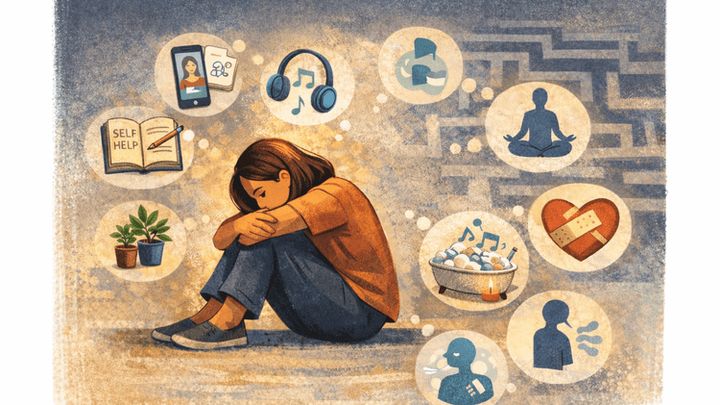
You’ve done the breathing exercises, the journaling, the grounding techniques. You know how to calm your body in the moment. But lately, it feels like those tools…
When I was growing up, my mom had lots of self-helpy books on her shelf. The middle school me never picked them up, but some of the titles stuck in my brain. For…